Executive Summary:
- You prepare for the EA course and understanding the syllabus becomes the first important step. It shapes preparation. If you’re wondering “what is EA”, EA stands for Enrolled Agent, a US taxation certification authorized by the IRS. It is globally recognized. And career-focused.
- EA salary in India continue to improve as demand for US taxation professionals grows. Opportunities are expanding. Across firms. In simple terms, proper planning and consistent preparation make the EA journey much smoother. And more manageable.
You plan to enter the field of US taxation and understanding the exam structure becomes important. Very important. The EA certification is specialized and students must prepare strategically to clear the exams successfully. Proper planning is needed. From the beginning.
If you are exploring the EA course, this guide will help you understand the syllabus, pattern, weightage and latest updates clearly. Step by step.
What is EA?
You hear the term often and clarity should come first. Always. If you are wondering “what is EA”, EA stands for Enrolled Agent, a tax professional authorized by the IRS in the United States. It is a globally recognized certification.
The certification focuses entirely on US taxation. And representation rights. An EA can represent taxpayers before the IRS. Professionally.
EA Course Details
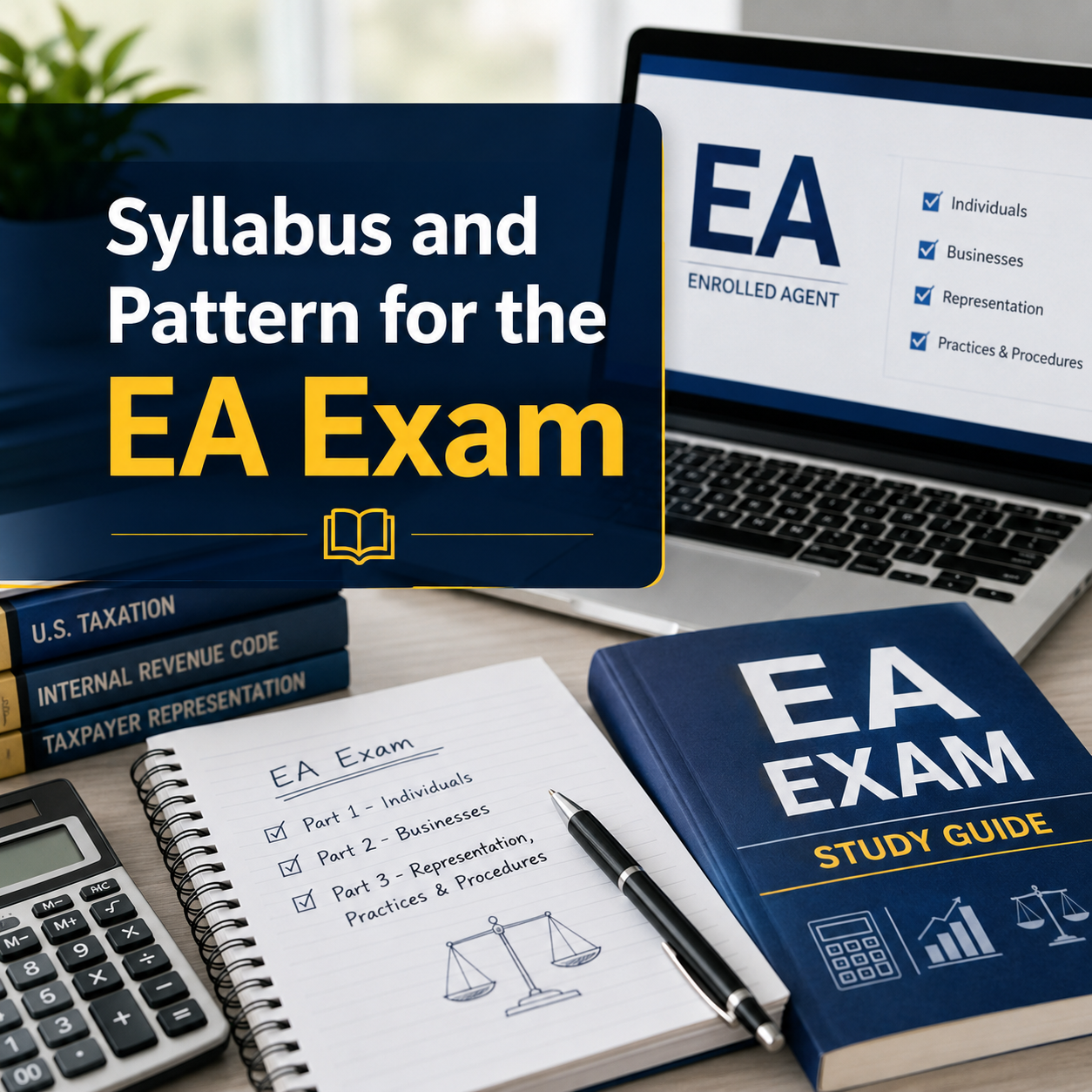
You explore the certification and structure becomes important. Naturally. As per complete EA course details, the program includes three exam parts that focus on taxation for individuals, businesses and representation procedures. The structure is well-defined.
Candidates must clear all three parts. To qualify. The exams are computer-based. And objective in nature.
Overview of the EA Exam Pattern
You prepare for exams and understanding the format helps. A lot. The EA exam is divided into three parts and each part focuses on different taxation areas. The syllabus is structured carefully.
Every exam includes multiple-choice questions. Only. Candidates are tested on practical tax knowledge and application. Understanding is required. Not memorization alone.
Part 1: Individuals
You begin with individual taxation and this section forms a major part of the syllabus. For many candidates. Topics include income, deductions, credits, retirement plans and tax filing requirements for individuals. Weightage is distributed across areas. Tax compliance concepts are tested heavily. In this section. Candidates must understand practical scenarios clearly. Before attempting questions.
Part 2: Businesses
You move into business taxation and complexity increases slightly. Compared to Part 1. This section covers partnerships, corporations, business deductions and accounting methods. Technical understanding is expected. Business tax rules are explained through application-based questions. In exams. Preparation should focus on concepts and calculations together. Not separately.
Part 3: Representation, Practices and Procedures
You study professional responsibilities and this part becomes different from the others. In approach. The section focuses on ethics, IRS procedures, representation rights and tax practice regulations. Professional conduct is emphasized.
Candidates are expected to understand compliance rules clearly. Practical knowledge becomes important here as well. Especially in scenarios.
You prepare smarter and weightage matters. Individual taxation often receives significant focus. In Part 1. Business taxation and representation concepts are also important. Across later sections.
Latest Updates in EA Exam Syllabus
You follow updates and preparation becomes more accurate. That matters. The IRS periodically updates tax laws and regulations and these changes are reflected in the exam syllabus. Updates are monitored regularly.
Students should always use updated study material. For preparation. Ignoring recent changes can affect performance negatively in exams.
EA Course Salary and Career Scope
You complete the certification and career opportunities expand. Quite significantly. The EA course salary depends on experience, skills and the type of organization but strong growth potential exists in taxation roles. Demand is increasing.
Many professionals work with MNCs and consulting firms. In India. The EA salary in India generally improves with experience and specialization in US taxation. Growth is steady. Over time.
Common Challenges Students Face
You begin preparation and challenges naturally appear. That is normal. Many students struggle with tax terminology and practical application initially and regular revision becomes necessary. Understanding takes time.
Balancing studies with work can feel difficult. Sometimes. Structured preparation reduces stress significantly. Over time.
Final Thoughts
You prepare for the EA course and understanding the exam structure gives you an advantage. Right from the start. Knowing complete EA course details, syllabus weightage and recent updates helps students prepare more effectively. Clarity improves performance.
If you are still asking “what is EA”, it is one of the strongest certifications for professionals interested in US taxation and global finance roles. Scope is growing. And opportunities are expanding. Stay consistent. And prepare strategically.


FAQs
- What is EA?
If you’re asking “what is EA”, EA stands for Enrolled Agent, a tax professional authorized by the IRS to represent taxpayers in the United States. It is a specialized certification. Focused on taxation.
- What are the EA course details?
As per complete EA course details, the certification includes three exam parts covering individuals, businesses and representation procedures. All parts must be cleared. To qualify.
- What is the pattern of the EA exam?
The EA exam follows a multiple-choice format and each part focuses on different taxation topics. Practical understanding is tested. Throughout the exam.
- How difficult is the EA course?
The EA course is considered moderately challenging because it focuses on detailed US taxation concepts. Consistent preparation is required for better results.
- What is the EA course salary?
The EA course salary depends on experience, role and employer. But professionals in US taxation often receive competitive packages. Growth is steady. With experience.
