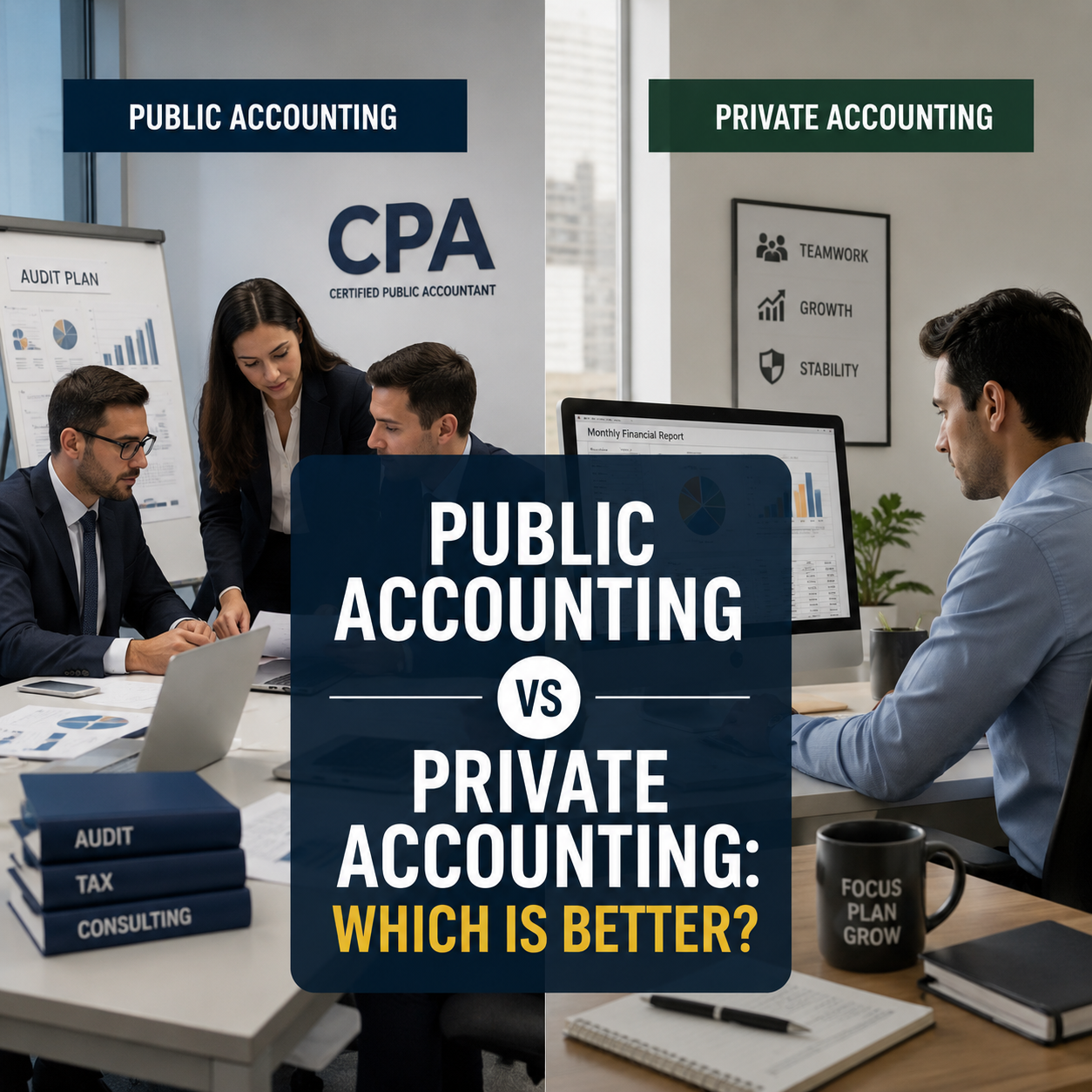
Executive Summary
- You explore accounting careers & choice between public and private accounting becomes important. Quite early. Public accounting refers to accounting services offered to multiple external clients through firms. The work is dynamic and client-focused.
- The private accounting meaning refers to accounting professionals working within a single organization. The environment is usually stable. And structured. Understanding difference b/w Public & Private Accounting helps students choose better. Based on work style, goals and preferences. The roles differ in many ways.
- Many students pursuing public accounting choose course like US CPA course. It provides strong expertise in auditing and taxation. Global opportunities increase with qualifications. The CPA qualification focuses on accounting, auditing and business concepts. Preparation requires consistency and conceptual clarity.
You choose a career in accounting and one major question appears early. Public or private? Both career paths offer strong opportunities but the nature of work is different. Expectations vary. And so does the work environment.
If you’re confused b/w Public & Private Accounting, this guide explains it in a simple way. Step by step.
What is Public Accounting?
You work with multiple clients and the role becomes highly dynamic. That is public accounting. If you’re wondering “what is public accounting”, it refers to accounting services offered by accounting firms. Services are provided externally.
Professionals handle auditing, taxation, consulting and financial reporting work. Across industries. Client interaction is frequent. And deadlines can be demanding.
What is Private Accounting?
You work within one company and your focus becomes internal operations. Quite different from public accounting. Private accounting means accounting professionals who work directly for a company. Instead of serving multiple external clients. Financial activities are managed internally.
These professionals handle budgeting and reporting for the organization. The work environment is usually more stable and structured.
Difference Between Public and Private Accounting
You compare both fields and the differences become clearer. Very quickly.
| Basis | Public Accounting | Private Accounting |
| Work Structure | Works with multiple clients | Works within one company |
| Main Focus | Auditing, taxation, consulting | Internal accounting and reporting |
| Career Growth | Broad exposure across industries | Deep specialization in one business |
| Working Hours | Can be longer during busy seasons | Usually more predictable |
| Interaction | Frequent client communication | Mostly internal coordination |
| Skill Development | Diverse technical exposure | Strong operational understanding |
| Common Employers | Accounting firms and consultancies | Corporates and private companies |
The difference between Public and Private Accounting depends on work and career goals. Choice matters a lot. Many students choose the US CPA course for this pathway globally.
US CPA Course and Public Accounting
You aim for global accounting roles and CPA often becomes the preferred qualification. Especially in public accounting. The US CPA course focuses on accounting, auditing, taxation and business regulations. And it is highly respected worldwide. Demand remains strong.
Professionals with CPA qualifications often work in Big 4 firms and multinational companies. Strong technical knowledge is developed during the program. Through structured learning.
CPA Course Details
You explore the qualification and understanding the structure helps. Before starting. As per official CPA course details, the program includes multiple exam sections. focused on accounting, audit, regulation and business concepts. Exams are standardized.
Eligibility requirements vary by state. In the US. Preparation requires consistency and conceptual clarity. Across subjects.
Public vs Private Accounting Pros and Cons
You compare both career paths and each comes with advantages and challenges. Naturally.
Public Accounting Pros
- Broad industry exposure is gained.
- Career growth can be faster.
- Networking opportunities are stronger.
The work environment is highly dynamic. And challenging.
Public Accounting Cons
- Long working hours may be required.
- Work pressure increases during peak seasons.
- Client deadlines can feel stressful.
Balance may become difficult. At times.
Private Accounting Pros
- Work schedules are usually more predictable.
- Stability is often better.
- Internal business understanding becomes stronger.
The environment feels more structured. For many professionals.
Private Accounting Cons
- Exposure may be limited to one industry.
- Career growth can feel slower in some roles.
- Variety in work may be less.
Routine tasks may increase over time. In certain positions.
Which Career Path is Better?
You ask the important question and the answer depends on your goals. Preferences differ. Career goals should guide your decision. Not trends. You should also consider work-life balance expectations before choosing.
Skills Needed in Both Fields
You enter accounting and core skills remain essential. In every role. Strong analytical ability and attention to detail are important in both. Communication skills also matter. Accuracy is expected.
Professionals must stay updated with regulations. And standards. Time management helps significantly. In accounting careers.
Career Opportunities in Accounting
You build experience and opportunities continue to grow. Across industries. Professionals in public accounting often move into audit, consulting and taxation roles. While private accountants may grow into finance management positions. Career paths are flexible.
The accounting industry continues to evolve. With technology. Global qualifications improve opportunities further. For professionals.
Final Thoughts
You compare public and private accounting and both offer rewarding careers. In different ways. Understanding the difference helps students make informed career choices. Based on their interests and work preferences. Clarity matters.
A public accounting course like US CPA course can open global opportunities. While private accounting offers stability and long-term organizational growth. Both paths are valuable. When chosen carefully. Think long term and choose wisely.

FAQs
- What is public accounting?
If you’re asking “what is public accounting”, it refers to services provided to external clients by firms. Services include auditing, taxation and consulting. Across industries.
- What is the private accounting meaning?
The private accounting meaning refers to accounting professionals working internally for one company. And also managing its financial operations. The role is organization-focused. And stable.
- What is the US CPA course?
The US CPA course is a globally recognized accounting qualification. It is focused on auditing, taxation and business regulations. It is highly respected. In the finance industry.
- What are the CPA course details?
As per official CPA course details, the qualification includes multiple exam sections. They are related to accounting, audit, regulation and business concepts. Eligibility varies by state.
