Executive Summary:
- You consider the EA and difficulty becomes the first concern. Naturally. If you’re asking “Is Enrolled Agent easy to pass?”, the answer is balanced. As the exam is not easy but is definitely manageable with the right preparation. Effort is required. And consistency matters.
- As per complete EA course details, the exam is divided into three parts. Each focused on US taxation and each section can be taken separately. Structure is flexible. And student-friendly.
- The difficulty mainly comes from understanding US tax laws. Especially for international students but the syllabus is focused compared to other courses. Scope is limited. And clear.
- With proper planning & practice candidates can pass the EA exam within a few months. Preparation drives results. More than anything else. In simple terms, the exam is challenging but achievable. If you stay consistent.
You start looking into the Enrolled Agent and one question comes up quickly. Is it really difficult? The answer depends on your preparation and background. But the exam is considered manageable with the right approach. It is structured and focused.
If you’re wondering “Is Enrolled Agent easy to pass?”, the honest answer is no but it is not extremely hard either. It requires effort. And consistency. Let’s understand it in detail.
What is the EA Exam?
You explore the course and clarity becomes important. Always. The Enrolled Agent exam is also known as the Special Enrollment Examination (SEE). It tests your knowledge of US taxation. It is conducted in parts.
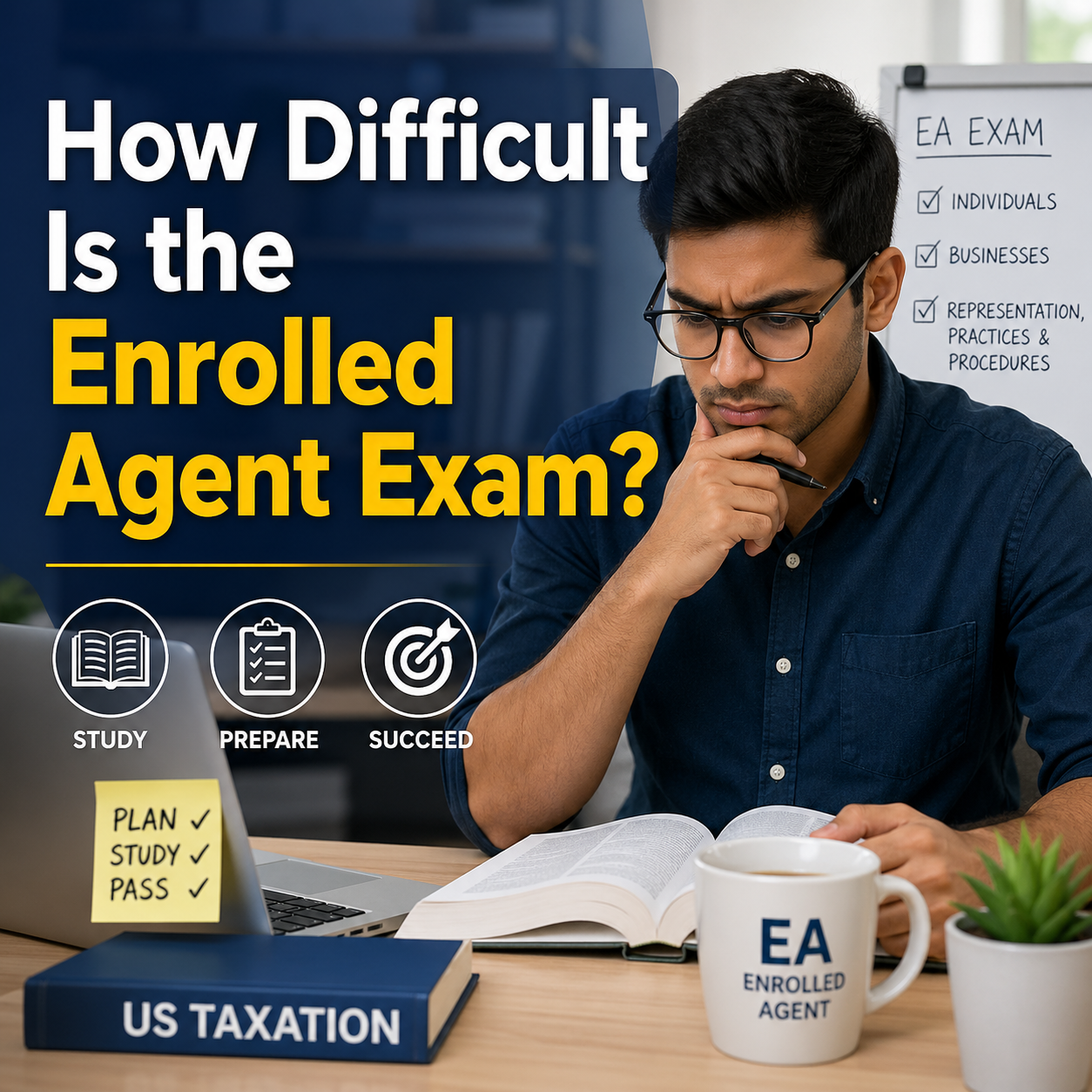
If you go through full EA course details, you will find that the exam has three sections. Structure is simple. And well-defined. These include:
- Individuals
- Businesses
- Representation, Practices and Procedures
Each part must be cleared. One by one.
EA Course Details and Exam Structure
You plan your preparation and structure helps. A lot. As per EA Course details, each exam part consists of multiple-choice questions. Also, candidates are tested on practical tax knowledge. Questions are application-based.
You need to understand concepts. Not just memorize. The exam can be taken one part at a time and flexibility is provided to candidates. Pressure is reduced. Compared to other courses.
Is Enrolled Agent Easy to Pass?
You ask this often and it deserves a clear answer. Honestly. If you’re thinking “Is Enrolled Agent easy to pass?”, it is not easy but it is achievable with proper study. Pass rates are moderate.
Candidates with a taxation background find it easier. Others may need more time. Consistent preparation improves your chances significantly and practice plays a major role. Effort is required. At every stage.
What Makes the EA Exam Challenging?
You start preparing and some areas feel tough. That’s normal. The exam focuses heavily on US tax laws which are unfamiliar for many international students. Concepts are detailed.
Rules change frequently. And must be updated. Time management can also be challenging as questions require careful reading. Accuracy is important. And speed matters.
What Makes the EA Exam Manageable?
You follow a plan and things become easier. Gradually. The syllabus is focused compared to other professional courses. Scope is limited. You can attempt one paper at a time. That reduces pressure.
With clear EA Course details, candidates can prepare in a structured way and track progress. Planning helps. And builds confidence.
How Long Does It Take to Prepare?
You set a timeline and it keeps you on track. That helps. Most candidates take 6 to 9 months to prepare for all three parts of the EA exam. It depends on your schedule.
Some complete it faster. Others take longer. Consistency matters more than speed. Always.
Tips to Pass the EA Exam
You prepare smartly and results improve. That’s the goal.
- Focus on understanding tax concepts instead of memorizing rules.
- Practice regularly.
- Take mock tests.
- And review mistakes.
Follow updated study material, as tax laws change frequently. Staying current is important. For success.
Who Should Consider EA?
You think about your goals and the choice becomes clearer. It should. The EA is ideal for those interested in taxation and IRS representation. Career paths are specific.
It is suitable for commerce students, accountants and finance professionals. Opportunities are growing. And global. If you prefer a specialized career, this is a strong option. Without doubt.
Final Thoughts
You look at the overall picture and the answer becomes clearer. It’s not impossible. If you’re asking “Is Enrolled Agent easy to pass?”, it requires effort. But it is achievable with the right preparation and mindset. The exam is fair.
Understanding complete EA course details helps you plan better and avoid confusion. Preparation becomes smoother. And more effective. Stay consistent. And results will follow.

FAQs
- Is Enrolled Agent easy to pass?
If you’re wondering “Is Enrolled Agent easy to pass?”, it is not easy but it is manageable with proper preparation. Consistency is important. And practice helps.
- What are the EA course details?
The EA Course details include three exam parts focused on taxation: Individuals, Businesses and Representation. The structure is simple. And well-defined.
- How difficult is the EA exam?
The EA exam is moderately difficult, mainly due to detailed tax laws and application-based questions. Effort is required. And understanding matters.
- How long does it take to complete EA?
Most candidates complete the EA exam in 6 to 9 months, depending on their preparation and schedule. It varies. For each student.
- Is EA easier than other professional courses?
Yes, compared to broader courses, the EA is more focused on taxation, which makes it relatively manageable. Scope is limited. And targeted.
- Who should pursue the EA course?
The EA is ideal for those interested in taxation and IRS-related roles. It suits commerce and finance students. And professionals.
- Do I need prior experience for EA?
No prior experience is required but basic knowledge of accounting or taxation can help. Learning is possible. From scratch.
