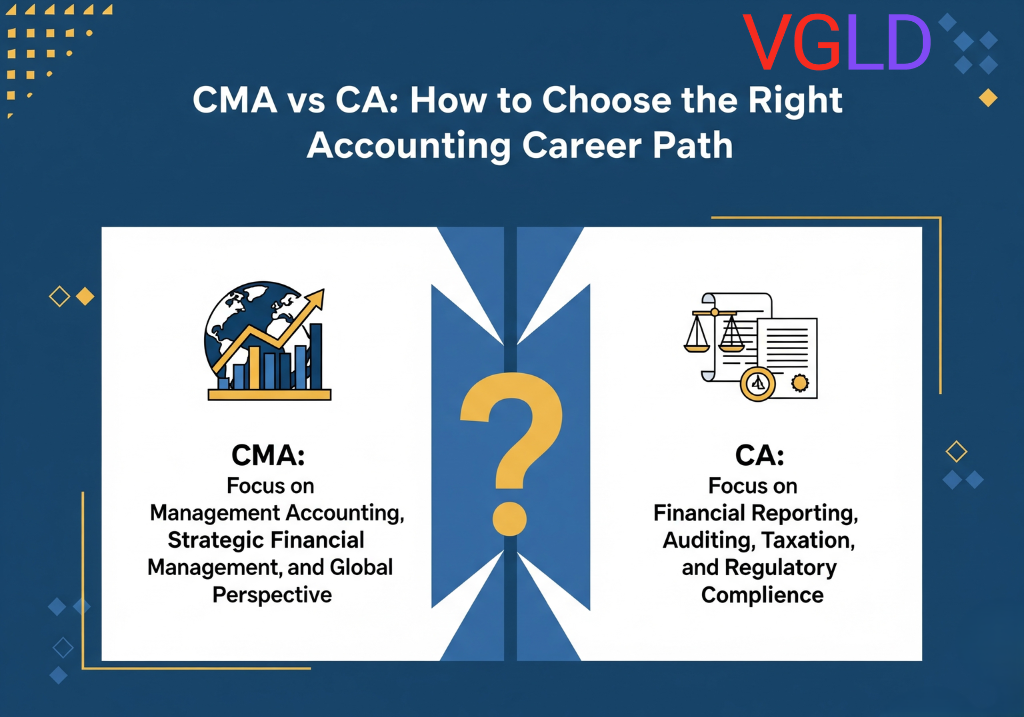
Choosing the right professional course is not an easy task, especially when it is about your career. It can be difficult to choose between two highly respected courses like Chartered Accountant and Certified Management Accountant. It is not just about choosing the best one, it is about investing years of effort and hard work into building a professional identity. Both CA and CMA have rewarding career opportunities but they both have different skill sets and career paths.
It is because some people find it difficult to differentiate between which one of them will align better with their interests and goals. Should you go for the well-established and broader route of CA or CMA which focuses on cost management and management accounting? The pressure to make the right choice can be overwhelming. One wrong choice can make years of regret and one right decision can get you a rewarding career. So, understanding both CA and CMA is important and the difference between them is as well.
What is CA?
Chartered Accountancy is one of the most well-known and globally recognised professional qualifications that focuses on financial accounting, auditing, taxation and business law. It shows that an individual has the knowledge and skills that are required for an accounting procedure. It is known as one of the most challenging careers in the field of finance and accounting. CA is awarded by a well recognised professional body called the Institute of Chartered Accountants of India (ICAI).
Skills of a Chartered Accountant
A Chartered Accountant role requires a combination of technical knowledge, soft skills and practical expertise. Here are the key skills required for a Chartered Accountant:
- Technical Accounting Skills
A CA must have a deep understanding of accounting principles and financial statements. They should excel in preparing these documents. The ability to conduct audits and check the accuracy of financial records is also important. A CA must also be skilled in taxation as well as management accounting like cost control, budgeting, financial forecasting etc.
- Analytical and Critical Skills
To spot problems in operations or financial statements, certified public accountants must also have strong problem-solving abilities. A CA must also be able to spot any discrepancies in financial records or tax calculations. A certified public accountant should be able to analyse trends, predict future financial positions and give clients actionable insights because they have access to so much data.
- Communication Skills
A CA is also expected to be proficient in drafting clear financial reports, audit reports and tax filings. They should be able to present the financial data and insights to shareholders. As a CA working directly with clients, communication skills are important for explaining tax strategies and financial advice clearly.
- Business Skill and Strategic Thinking
A CA needs to understand how financial decisions impact the broader businesses. They must know how to identify financial risks and make sure that the organisation is compliant with financial and regulatory risks.
- Leadership and Management
A CA may need to lead a team in auditing and consulting roles. They also make important financial decisions so they must have sound judgement to make the decisions that align with the company’s financial health.
How to become a CA?
- You will have to complete your 10+2 and register for the foundation course. Graduates with a commerce background can directly enter the IPCC level.
- Study and clear the Intermediate exams which cover advanced subjects in accounting, taxation and auditing.
- Then you will have to complete 3 years of practical training under a qualified CA or firm.
- After completing the articleship, appear for the CA final exam. These levels cover the advanced topics.
- Once you pass the CA final exams and complete your articleship, you can then apply for membership with the Institute of Chartered Accountants of India (ICAI).
What is CMA?
The full form of US CMA is Certified Management Accountant. US CMA is the highest level of certification for management accounting. It is awarded by IMA, USA i.e Institute of Management Accountants. This certification is for those who wish to work in the accounting and finance related sector. It prepares you for decision-making roles so that you can lead and guide the organisation/team members.
Skills of a Certified Management Accountant
- Strategic Leadership And Performance
US CMAs are often the first ones to design strategies related to accounting, operations, and bookkeeping with the help of their deep understanding of financial statements and the right process. Performance management is also a core skill of CMAs that helps candidates improve results across departments.
- Reporting, Control and Risk Management
All the USA CMAs are the trusted advisors in reporting and financial control that contribute to preserving the organisation’s financial stability, which is also one of the benefits of the US CMA course. They measure and manage financial risks to help businesses make safer and smarter decisions.
- Technology, Analytics and Financial Analysis
With the US CMA course subjects that cover AI and ML, CMAs are prepared for modern financial analysis and tech-driven decision-making. US CMAs break down complex financial data and turn it into clear information for business leaders to understand, which can be acquired in the US CMA course details.
- Business Operations and Leadership
US CMAs shape business strategies, and this knowledge is taught in the US CMA course, which improves decision-making. Since managing is in the title of a US CMA, one of the most important traits is the ability to manage a team.
- Ethics and Communication
A US CMA’s ability to lead others makes sure of their professional values and ethics. US CMAs explain financial matters in a way everyone understands, for which they are proficient in communicating.
- Budgeting, Forecasting and Cost Accounting
They are experts at planning budgets and predicting future trends using their financial knowledge acquired through the US CMA course. One of the benefits of the US CMA is holding out measurable responsibilities for leaders and stakeholders.
How to Become a CMA?
- You will have to see if you are eligible for the exam, you must have a bachelor’s degree from an accredited college or university. Either that or you must hold a related professional certification.
- You will have to register for the exams and successfully clear both part 1 and part 2.
- Then, you will have to fulfil the 2 years of experience in management accounting or financial management. This requirement may be completed prior to or within seven years of passing the examination.
- After completing the exams and experience, you can apply for your CMA Certificate.
CA vs CMA: Considerations when choosing the right course
Choosing between CA and CMA is an important decision for those who are interested in a career in accounting and finance. Both qualifications provide a rewarding career but the passing percentages, salary potentials etc, can differ. So, here are some factors that can help you make an informed decision between CA and CMA.
CA vs CMA Syllabus Comparison
CA Syllabus:
The syllabus of CA is wide and it is completed in 3 levels: Foundation, Intermediate and Final. It is focused on accounting, auditing, taxation and business law. Here are some subjects of each level:
Foundation Level: Basics of Accounting, Business Law, Economics, Quantitative Aptitude, Business Communication and Logical Reasoning.
Intermediate Level: Advanced Accounting, Corporate and Other Laws, Auditing, Taxation and Management Accounting.
Final Level: Advanced Auditing, Corporate Finance, Financial Reporting, Direct Tax Laws, Indirect Tax Laws, Strategic Financial Management and Business Strategy.
CMA Syllabus:
The CMA course syllabus is more focused on management accounting, financial management and strategic decision making. The CMA syllabus is divided into 2 parts:
Part 1: Financial Planning, Performance and Analysis. This includes topics like: Budgeting, Forecasting, Performance Management, Cost Management, Technology and Analytics.
Part 2: Strategic Financial Management: This part focuses more on areas like risk management, decision analysis, Investment Decisions, Professional Ethics and Corporate Finance.
CA’s syllabus is more focused on auditing and taxation while CMA’s syllabus is more focused on management aspects.
CA vs CMA Passing Percentage
The passing percentage is one of the major factors that matter in the choice between CA and CMA. Both courses have challenging exams but their passing rate is different.
CA exams are known for their high difficulty level and low passing rates. The average pass rate of the CA exam is around 8.27%.
In comparison to CA, the CMA passing rate is higher. The average passing rate of CMA exams is 45-50%.
CA vs CMA Salary Difference
Chartered accountants are known for their expertise in fields like accounting, auditing and taxation. Their earning potential is higher as their starting salary is around 8 to 10 LPA. With experience it goes much higher, up to 18 to 22 LPA.
Certified management accountants’ salaries are generally lower than those of CAs. With less than 3 years of experience, you can earn an average income of 8 to 10 lakhs per year.
Key Differences Between CA and CMA
| Aspect | Chartered Accountancy (CA) | Certified Management Accounting (CMA) |
| Focus | Broad focus on accounting, auditing, taxation and business law. | Focuses on management accounting, financial strategy and decision-making. |
| Exams | Three levels: Foundation, Intermediate and Final. | Two parts: Part 1 (Financial Planning, Performance and Analysis) Part 2 (Strategic Financial Management). |
| Passing Percentage | Low pass rate around 8-10% | Higher passing percentage around 40-50%. |
| Training Requirement | 3-year articleship | 2 years of experience |
| Salary Potential | Higher earning potential particularly in senior roles. | Lower starting salary compared to CA but competitive in management roles globally. |
| Professional Body | Institute of Chartered Accountants of India (ICAI). | Institute of Management Accountants (IMA) |
| Ideal For | Individuals seeking a broad-based career in accounting, taxation and auditing. | Individuals looking fo roles in financial decision-making and strategic planning. |
Conclusion
The decision of choosing between Chartered Accountancy and Certified Management Accounting depends on your interests and career goals. Both qualifications have great career opportunities but they have specialities in different areas. CA is perfect for those who are interested in a broader career in accounting, auditing, taxation and business law. CA is a great option for those who are aiming for a high-level role in finance and business. On the other hand, CMA is perfect for those who are interested in budgeting, forecasting and cost management. CMA is a great option for those who want an equally rewarding career path as CA but don’t want to go the traditional method.
For those who want to go with the CMA qualification, VG Learning Destination is one of the best CMA course institutions in India in 2026. They also provide live + recorded lectures, weekend and weekday classes and doubt-clearing sessions.
Frequently Asked Questions
- Is the US CMA easy to pass?
Since the average rate of passing aspirants is 45% which is less than half the total aspirants appearing for the exam. The difficulty of the US CMA examination is quite hard but with the right guidance like VG Learning Destination, the top CMA course institution in India, one can definitely be able to crack it in months.
- Is the US CMA tougher than the CA?
No, the US CMA is generally considered easier than the CA. It has a shorter duration, a more focused syllabus and higher pass rates, which makes it more manageable for most students.
- How long does it take to complete CMA as compared to CA?
CMA can be completed in as little as 6 to 9 months. CMA has a maximum time limit of 3 years from the date of registration. While completing 3 levels of CA along with 3 years of mandatory articleship, it can be completed in 4 to 5 years.
