Quick Overview
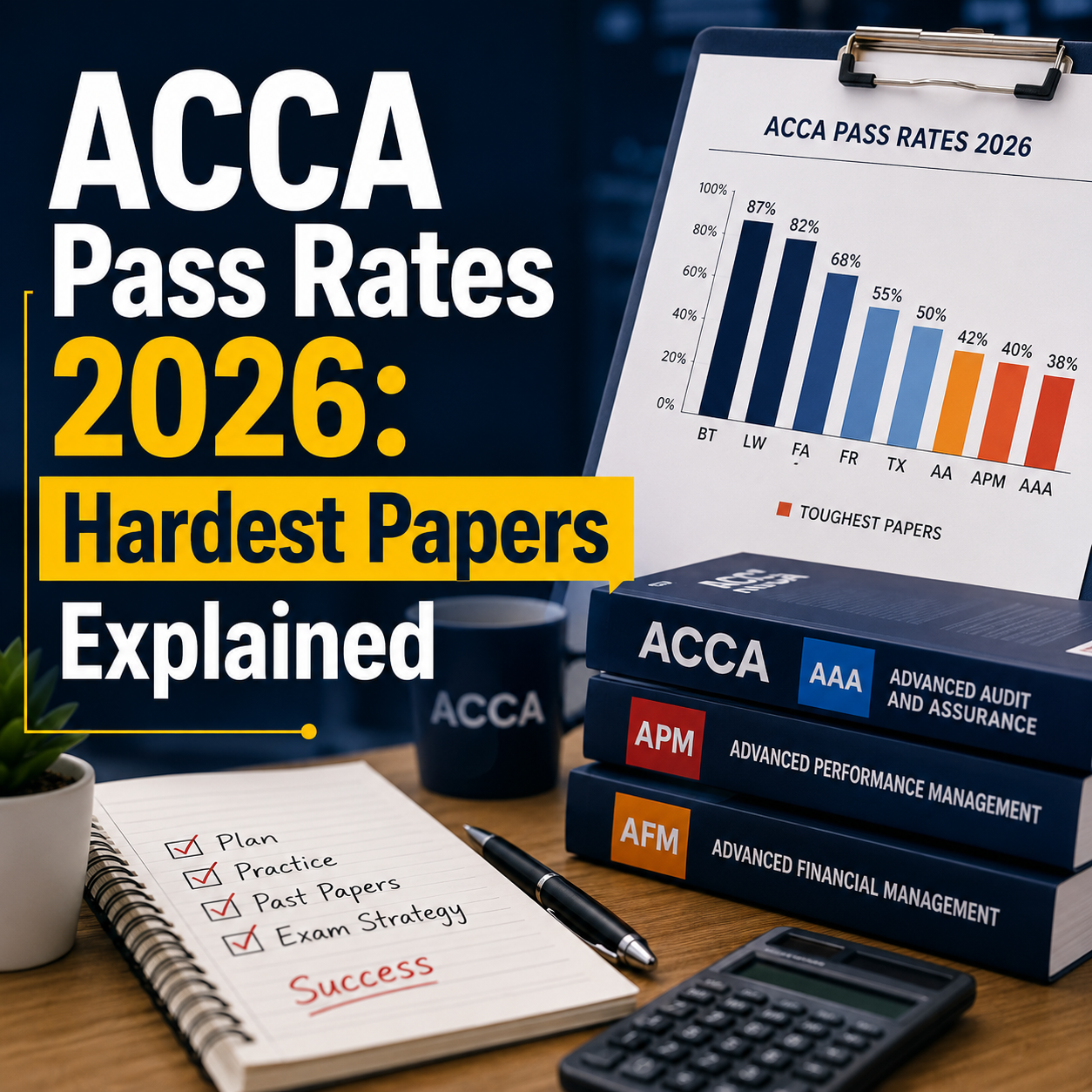
Pass rates tell you something useful about the ACCA qualification but only if you read them carefully. The Applied Knowledge papers regularly clear 60% to 87% of candidates. While the Strategic Professional optional papers sit between 38% and 50%. The toughest paper in recent sittings has been AAA, with APM running it close.
What follows is a paper-by-paper view of pass rates, an honest look at why some papers are harder and a practical note on how this plays out for Indian candidates pursuing the ACCA course.
The Full Form of ACCA and Why Pass Rates Matter
The full form of ACCA Course is the Association of Chartered Certified Accountants. A UK-headquartered professional body with members in over 180+ countries. Its qualification is built around 13 examinations spread across three stages, supplemented by an Ethics and Professional Skills module and a Practical Experience Requirement. Anyone studying for the qualification ends up looking at pass rates sooner or later and there is a reason for that.
Pass rates are not just a curiosity. They shape how a candidate sequences papers, how much study time gets allocated and which papers should be attempted in fresher, more disciplined sittings rather than alongside a heavy work week. The numbers also clear up a common worry. Plenty of students arrive expecting CA-style pass rates of 5% to 15%, only to find ACCA’s pattern is markedly different.
How ACCA Pass Rates Actually Work
After every quarterly sitting in March, June, September and December, ACCA publishes a paper-wise pass rate. Each figure is the percentage of candidates who scored 50 marks or more in that session. So if 10,000 candidates sat for Financial Reporting and 5,100 cleared, the pass rate is reported as 51%.
A few features of the system are worth flagging before you read the table. Applied Knowledge papers run as on-demand computer-based exams, so candidates choose their date and tend to sit when ready. The other papers are session-based with fixed dates. This explains a real chunk of the gap between the entry-level and later-level numbers. The session-based papers also bring different question types: longer constructed-response questions, integrated case studies at Strategic Professional and far less mark-by-mark scaffolding than CBEs offer.
Another point that often gets missed: a low pass rate does not mean the topic is intellectually beyond you. It usually signals that the exam tests a different skill, generally written professional judgement under time pressure and that many candidates have not practised that skill enough.
The Latest ACCA Pass Rates, Paper by Paper
| Level | Paper | Code | Dec 2025 Pass Rate | March 2026 Pass Rate |
| Applied Knowledge | Business and Technology | BT | 87% | On-demand |
| Applied Knowledge | Management Accounting | MA | 64% | On-demand |
| Applied Knowledge | Financial Accounting | FA | 68% | On-demand |
| Applied Skills | Corporate and Business Law | LW | 82% | On-demand |
| Applied Skills | Performance Management | PM | 40% | 45% |
| Applied Skills | Taxation | TX | 55% | 53% |
| Applied Skills | Financial Reporting | FR | 51% | 50% |
| Applied Skills | Audit and Assurance | AA | 46% | 43% |
| Applied Skills | Financial Management | FM | 48% | 50% |
| Strategic Professional (Essential) | Strategic Business Leader | SBL | 50% | 52% |
| Strategic Professional (Essential) | Strategic Business Reporting | SBR | 48% | 50% |
| Strategic Professional (Optional) | Advanced Financial Management | AFM | 45% | 44% |
| Strategic Professional (Optional) | Advanced Performance Management | APM | 41% | 40% |
| Strategic Professional (Optional) | Advanced Taxation | ATX | 49% | 50% |
| Strategic Professional (Optional) | Advanced Audit and Assurance | AAA | 38% | 42% |
A few patterns jump out. The Applied Knowledge papers all clear comfortably above 60%, as does LW, which remains an on-demand CBE. Once you reach Applied Skills, the numbers settle into a 40% to 55% band. At Strategic Professional, the two Essentials hold steady around 50%, while three of the four Optionals (AAA, APM and AFM) consistently come out lowest. AAA’s 42% in March 2026 was actually its highest result in roughly 15 years, which gives you a sense of how stubborn this paper has been historically.
The Hardest ACCA Papers and Why
Rather than walking through every paper in order, this section looks at the ones that genuinely cause problems and explains what makes them difficult.
1. Advanced Audit and Assurance (AAA)
AAA has long been the lowest-scoring paper in the qualification and the reason is straightforward once you sit it. The exam does not test whether you can recall audit procedures. It tests whether you can spot the audit risks hiding inside a long & ambiguous case scenario and write about them with professional scepticism.
Time pressure makes the paper harder still. If your writing speed is slow or your structure is loose, the marks slip away regardless of what you know. Practising past papers under strict time discipline is the single most useful thing you can do here.
2. Advanced Performance Management (APM)
APM rivals AAA for the toughest-paper title and often beats it. The technical content, things like performance pyramids, balanced scorecards and transfer pricing, is not the issue. What trips candidates up is the level of integration the examiner expects. You are asked to assess whether a particular performance measurement system fits a specific organisation’s strategy, then critique it, then suggest improvements, all in a structured business report.
Examiner reports keep repeating the same point: candidates describe models instead of using them. Writing “the balanced scorecard has four perspectives” earns very little. Showing how the company’s customer perspective is letting down its strategy, with reference to the case data, earns far more. APM rewards practice on full case studies more than it rewards rereading the textbook.
3. Advanced Financial Management (AFM)
AFM is the heaviest calculation paper in the qualification. Investment appraisal, M&A valuation, complex hedging using forwards, futures, options and swaps, treasury management and corporate restructuring all sit inside this syllabus. The pass rate has been pulled up in recent sittings (45% in December 2025) but the paper still rewards a very specific profile: someone who is quick and accurate with calculations and can also write a sensible commentary on what the numbers mean.
For Indian candidates with a CA background, AFM is often the most natural Optional to pick, since hedging and valuation are familiar terrain. Candidates coming straight from a B.Com route generally need more time on the calculation-heavy areas.
4. Performance Management (PM)
PM sits at Applied Skills but it has been one of the most reliably difficult papers in recent years. The December 2025 pass rate was 40% and although March 2026 lifted to 45%, the paper has trended downward over a decade-long view. Costing techniques, variance analysis, budgeting and short-term decision-making all need to be applied to scenario-based questions where the numbers are not handed to you on a plate.
The trap with PM is that the topics feel familiar from earlier study, so candidates assume the paper will be similar. It is not. The questions require you to choose the right technique for the situation, calculate cleanly and explain your reasoning. Mock exams under timed conditions are the only honest way to test whether you have got there.
5. Strategic Business Reporting (SBR)
SBR usually clears between 45% and 50%, so on a pure-numbers basis it is not the hardest paper. It earns a mention here because of how candidates misread it. SBR tests professional judgement on IFRS, current developments in financial reporting and the ethical responsibilities of a corporate accountant. The questions look familiar to anyone who passed Financial Reporting, which lulls some candidates into preparing in the same way. SBR demands more written justification and more cross-standard thinking than FR ever did and that gap shows up in the marks.
The Easiest ACCA Papers, in Context
It feels odd to talk about easy papers in a qualification that is genuinely demanding but the data is clear: BT, LW, FA and MA consistently record the highest pass rates. There are two main reasons for that.
None of this means you can coast through the early papers. Strong fundamentals at Applied Knowledge make every later paper easier. And the habits you build here, careful reading and timed practice are the same habits that decide outcomes at AAA two years later.
The ACCA Pass Rate in India: What the Data Tells Us
- A large share of Indian ACCA candidates have already done a B.Com, CA Inter or CA Final. That technical base, especially in financial accounting, taxation and audit, gives them a head start at Applied Skills.
- The structured coaching ecosystem in India is mature. Most candidates study with a Gold or Platinum Approved Learning Partner rather than entirely on their own.
The flip side is also real. Indian candidates can run into trouble at Strategic Professional precisely because the writing style demanded by examiners differs from what Indian commerce education trains. Practising structured, business-report-style answers matters more than absorbing one more chapter of theory.
What This Means for How You Plan Your ACCA Course
Pass rate data is most useful when it shapes your sequencing rather than just reassuring or scaring you. A few practical points come out of the figures above. Sit your Applied Knowledge CBEs early and quickly while motivation is high. They build the habit of passing and clear up the easier marks. At Applied Skills, do not save PM for a busy work quarter; its pass rate tells you it deserves a sitting where you can put in the hours. AA and FM benefit from being paired thoughtfully rather than crammed together. At Strategic Professional, leave AAA or APM until you are already through SBL and SBR, since the writing discipline you build on the Essentials directly helps you with the Optionals.
Resitting is part of the journey for many candidates. A 45% global pass rate means roughly one in two people sitting that day does not clear and that has very little to do with how clever they are. It usually comes down to time management, exam technique and the realism of mock practice. For a fuller view of the qualification including exemptions, eligibility and timelines, see our ACCA course details page.
ACCA Salary in India: Why the Effort Pays Off
The other reason to look at pass rates with steady eyes rather than panic is that the qualification, once cleared, opens up a salary trajectory that justifies the effort. ACCA salary in India in 2026 typically begins between 4 and 8 LPA for freshers, with Big 4 firms (Deloitte, PwC, EY and KPMG) and GCCs paying at the higher end of that range. Three to five years in, salaries usually sit in the 10 to 18 LPA band. Senior roles in financial reporting, FP&A, treasury and IFRS advisory can take experienced ACCAs past 25 LPA and beyond 40 LPA for leadership positions in larger firms.
Skills that lift the figure include IFRS expertise, SAP or other ERP exposure, data analysis and the ability to communicate clearly with non-finance colleagues. The same logic applies abroad. ACCA is recognised in the UK, the Middle East, Singapore and most ACCA-recognised markets, which means the qualification gives you optionality as much as it gives you a paycheque. For a fuller salary breakdown, our guide on ACCA salary in India goes into city-wise and role-wise figures.
How to Use Pass Rates in Your Study Strategy
A short checklist of what actually works, drawn from how our higher-performing candidates approach the exams:
- Read the examiner’s reports. ACCA publishes these after every sitting and they spell out where candidates lost marks. Patterns repeat across years.
- Get your writing style right before you reach Strategic Professional. Structured headings, short clear paragraphs and direct application of the case data are non-negotiable for SBL, SBR, AAA and APM.
- Pair Optionals with your Essentials sensibly. AFM pairs well with SBR for reporting-heavy candidates; AAA pairs with SBL for those leaning toward audit and assurance careers.
A Closing Thought
Pass rates can do two things to a candidate. They can intimidate, if read in isolation or they can clarify, if read as a map of where the qualification asks more of you. ACCA’s numbers are not low because the body wants to fail students. They are what they are because the Strategic Professional papers test judgement, application and written communication at a level that takes real practice to reach. Plan your sittings around that fact and the path through the ACCA course becomes much more navigable than the global pass rate alone might suggest.


Frequently Asked Questions
AAA and APM are the two papers with the lowest pass rates session after session. So, they are often considered the most difficult.
Country-level pass rates are not published by ACCA, and therefore, there is no official India-only figure. Approved Learning Partners in India typically report cohort pass rates higher than the global average. And Indian candidates often perform at or above the global benchmark, especially on Applied Skills papers.
Unlimited attempts are allowed but all Strategic Professional papers must be completed within seven years of clearing your first one. The session-based papers run four times a year (March, June, September, December), Applied Knowledge and LW are on-demand CBEs.
